Showing posts with label Magna Carta. Show all posts

Friday, May 19, 2023

HOW TO OPPOSE GOVERNMENT OVERREACH

A Founding Built Against Unbridled Power: Principle of Civic Duty to Rein In Overreaching Government – Constituting America

Principle of civic duty to rein in overreaching government. “They tell us, sir, that we are weak; unable to cope with so formidable an adversary. But when shall we be stronger? Will it be the next week, or the next year? Will it be when we are totally disarmed, and when a British guard shall be stationed in every house?” – Patrick Henry, speech delivered at St. Johns Church, Richmond, Virginia, March 23, 1775 (“Give me liberty” quote was attributed to Patrick Henry, believed originally from William Wirt).

When and how should citizens confront abuses of power by their government?

This is a fundamental question that has shaped political discourse for centuries.

Patrick Henry, and the other colonial leaders who galvanized opposition to the predations of George III, drew upon English legal precedents and Enlightenment philosophy.  They built their rebellion against tyrannical overreach on foundations laid by their English ancestors.

There has always been conflict between those who desire unbridled power and those they govern.  Often this conflict was settled through force of arms.  On June 15, 1215, it was settled by force of law.

Rebelling English nobles forced King John to sign a “Great Charter of Freedoms”, now known as the Magna Carta.  The Charter became the basis for English Common Law and the laws of most English-speaking nations, particularly the United States. 

While the Magna Carta focused on individual rights and the legal system (such as trial by jury), Clause 61 empowered citizens to rein-in overreaching government. It created a Council of 25 barons to monitor and enforce King John’s compliance with the Magna Carta.  This included controlling feudal payments to the Crown, and by implication how the Crown spent “public” funds and governed.  Clause 61 included real sanctions: If John did not comply with the provisions of the Magna Carta, “the 25 barons were empowered to seize the King’s castles and lands until, in their judgement, amends had been made”.

King John colluded with the Pope to undermine the Magna Carta, but his successors reissued it and it became a formal part of English law.

During the 13th through 15th centuries Magna Carta was reconfirmed at least 32 times. The first item of parliamentary business was a public reading and reaffirmation of the Magna Carta.

The Stuart line of kings challenged the four-hundred-year Magna Carta balance of power to their peril. King Charles I asserted he would not be reined-in by Parliament.  This led to civil war and his beheading in 1649.  During the post-Civil War Restoration, Charles II adopted a more passive approach to governing.  However, James II ignored his elder brother’s compliance with Parliamentary restrictions, which led to his being overthrown during the “Glorious Revolution” of 1688.

Parliamentary ascendancy, and ultimate permanent dominance under a “Constitutional Monarchy”, was buttressed by philosophical publications.  These writings gave broader context to how power must be reined-in and how it should be done under law.

In 1680, Henry Care published English Liberties.  It established individual rights as bestowed at birth, not by government. Care formally asserts, “each man having a fixed Fundamental Right born with him as to the Freedom of his Person and Property in his Estate, which he cannot be deprived of, but either by his consent, or some Crime for which the Law has Imposed such a Penalty as Forfeiture”.  He describes the balance of a reined-in government, “qualified Monarchy, where the King is vested with prerogatives sufficient to support Majesty; and restrained from power of doing himself and his people harm”. 

Care supported his philosophical doctrine with a compendium of foundational political documents.  He made the Magna Carta central to history and to the contemporary legitimacy of individual freedom and control of government overreach. English Liberties became very popular in British reform (Whig) circles and widely read among leaders in the American colonies.

Even more popular among colonial thinkers and activists was John Locke’s Two Treatises of Government published in 1689.

Locke’s Second Treatise describes the importance of a civilized society based on natural (God given) rights.  It supports the social contract theory of the governed consenting to limited government in exchange for a secure and stable environment in which individual activity and commerce can thrive.  It became the primary conceptual work defining traditional 18th and 19th Century Liberalism.

Locke’s Second Treatise was frequently cited in Colonial debates about George III’s taxes and other punitive measures that comprised the King’s overreach and over reaction to colonial freedom. 

Locke describes the balance of power between an executive (or monarchy), which is a "Power always in being that must perpetually execute the law”, and the legislature, which is the "supreme power of the Common wealth…governments are charged by the consent of the individual, i.e. the consent of the majority, giving it either by themselves, or their representatives chosen by them."

Locke promotes the proposition that a full economic system could exist within the “state of nature”. Property predates the existence of government.  Society should be dedicated to the protection of property.  He expanded on Care’s “social contract” theory and explains how the “consent of the governed” may be withdrawn when power is abused, thus serving to rein-in government overreach.

The philosophy of Two Treatises is echoed throughout the Declaration of Independence. Thomas Jefferson wrote: "Bacon, Locke, and Newton - I consider them as the three greatest men that have ever lived, without any exception, and as having laid the foundation of those superstructures which have been raised in the Physical & Moral sciences".

The foundations of the Magna Carta, English Common Law, and the writings of Care and Locke birthed our nation.  They guide and inspire citizen oversight and empowerment to this day.


Thursday, April 19, 2018

NO ONE IS ABOVE THE LAW


CONSTITUTING AMERICA” SERIES ON CONGRESSIONAL HISTORY

Our U.S. Constitution (1787), and powers of the Legislative Branch, embody the distrust of concentrated power and establish mechanisms to hold that power in check. This concern for “sovereign over reach”, and the ways to prevent it, flow from the Charter or “Carta” signed on the field of Runnymeade in 1215.

On May 26, 1976, in a solemn ceremony at Westminster Hall in London, the leaders of the U.S. House of Representatives and Senate received a gold-embossed reproduction of the Magna Carta. On June 3, 1976, a second ceremony, in Washington, DC, installed the gold reproduction and the original Wyems copy of the Magna Carta in the Capitol Rotunda to celebrate America’s Bi-centennial.

While the original Magna Carta returned to England, the gold Magna Carta remains on permanent display in the Capitol. “Nothing could be more symbolically important to the people of the United States,” stated Speaker Carl Albert during the ceremony.

Why is the Magna Carta so firmly linked to America’s Legislative Branch? How are the underlying principles of the Magna Carta embodied in the operations of the Congress?

Winston Churchill, in his masterpiece, “A History of the English Speaking Peoples”, explained, “Throughout the document [Magna Carta] it is implied that here is a law which is above the King and which even he must not break. This reaffirmation of a supreme law and its expression in a general charter is the great work of Magna Carta; and this alone justifies the respect in which men have held it.”

England’s King John was humbled by barons at Runnymeade on June 15, 1215. The King had over reached as an aspiring despot. The barons had the military force, and the political will, to assert there were limits to even a King’s power. Magna Carta was the contract that re-established the rule of law and re-asserted certain rights for the ruling class. This included forbidding the King from compelling certain actions, and prevented him from imposing punishments and fines except through due process within narrowly defined cause.

England would expand upon these basic principles as Parliament gradually replaced the Monarchy in governing the nation. This process required a Civil War (1642-1647), the beheading of King Charles I (1649), and the deposing of King James II (1688).

America’s Revolution (1775-1781) and Declaration of Independence (1776) arose from a similar concern over King George III’ssovereign over reach”. 

Magna Carta’s revolutionary concept of holding the King accountable for a breach of contract with England’s nobles was broadened in the Declaration of Independence. Thomas Jefferson established rights above Common Law and Medieval precedents with the famous phrase, “We hold these truths to be self-evident, that all Men are created equal, that they are endowed by their Creator with certain unalienable Rights.”

The U.S. Constitution put this broader interpretation of Magna Carta into practice. Alexander Hamilton, James Madison, and John Jay, writing in Federalist 84, explain:

It has been several times truly remarked that bills of rights are, in their origin, stipulations between kings and their subjects, abridgements of prerogative in favor of privilege, reservations of rights not surrendered to the prince. Such was MAGNA CARTA, obtained by the barons, sword in hand, from King John...Here [in America], in strictness, the people surrender nothing; and as they retain everything they have no need of particular reservations. “WE, THE PEOPLE of the United States, to secure the blessings of liberty to ourselves and our posterity, do ordain and establish this Constitution for the United States of America.” Here is a better recognition of popular rights.”

The U.S. Constitution builds upon centuries of Parliamentary precedent by placing the power of legislation, and the funding of government operations, clearly in the hands of the Legislative Branch. This is why Article I begins, “All legislative Power herein granted shall be vested in a Congress of the United States...”

It is not a coincidence that Article I, the Legislative Branch, is more than double the size of Article II, the Executive Branch, in defining power and authority (2,282 words to 1,023 words). The final section on the Executive Branch establishes Congress’ ultimate sanction against “sovereign over reach”:

Section. 4. The President, Vice President and all Civil Officers of the United States, shall be removed from Office on Impeachment for and Conviction of, Treason, Bribery, or other high Crimes and Misdemeanors.

From the very first, the Legislative Branch asserted its role in limiting Executive Power. Senators quickly and effectively embraced the limitation of the President to appoint only with the “the Advice and Consent of the Senate” (Article II, Section 2).

The first test was rejecting President George Washington’s appointment of Benjamin Fishbourn to be a customs collector. On August 5, 1789, President Washington strode unannounced into Federal Hall in New York City, then the Capitol Building. Vice President John Adams allowed Washington to sit in the presiding officer’s chair. The President, according to Ron Chernow’s definitive biography on Washington, “proceeded to unbraid the twenty-two members of the Senate, demanding to know why they spurned his appointee.”

Senator Ralph Izard of South Carolina spoke for the institution asserting that “the Senate had no obligation to explain its reasoning to the President”. It was the last time Washington, or any other President, entered a Legislative Chamber without permission.

Battles over appointees, spending, and legislation have defined the balance of power between the Congress and the President. In each encounter, Congress has ultimately reaffirmed its power to limit “sovereign over reach”. This has included censuring President Andrew Jackson (1834) and impeaching Presidents Andrew Johnson (1868), Richard Nixon (1974), and Bill Clinton (1998-1999).

The “Lincolnia” original of the Magna Carta was displayed at the New York World’s Fair in 1939. It remained safe in America during World War II, even being stored in the vault of Fort Knox after the Pearl Harbor attack. 

America kept the physical Magna Carta safe, and kept Magna Carta’s revolutionary legacy of holding power accountable.

[Scot Faulkner advises corporations and governments on how to save billions of dollars by achieving dramatic and sustainable cost reductions while improving operational and service excellence. He served as the Chief Administrative Officer of the U.S. House of Representatives. He also served on the White House Staff, and as an Executive Branch Appointee.]

Saturday, February 24, 2018

WHY REPRESENTATIVE GOVERNMENT?


“CONSTITUTING AMERICA” SERIES ON CONGRESSIONAL HISTORY

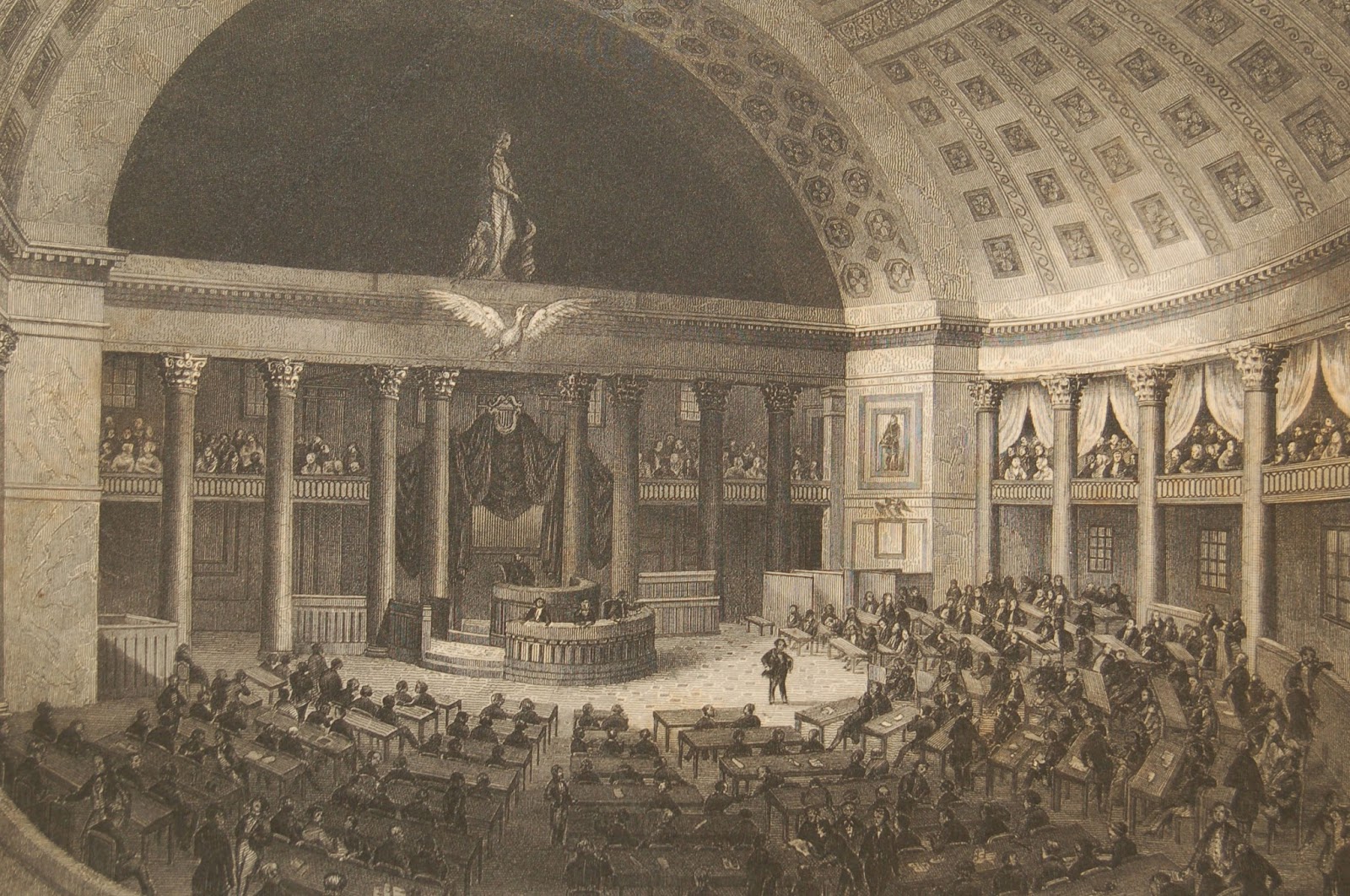
House History – Purpose of the United States House of Representatives as the immediate will of the people and how it differs from the Senate

The reason the U.S. House of Representatives is so different from the U.S. Senate is deeply rooted in the history of representative democracy.

Since the first time hunter gatherers sat around a campfire, leaders depended upon the advice of trusted counselors. These advisors evolved into a lord’s or noble’s Privy Council, and eventually into the “upper chambers” of many democracies, such as Britain’s House of Lords. These members were chosen “from above” – directly by the noble, not “from below” – by the people. In America, the U.S. Senate was based on being chosen “from above” by State Legislatures until April 8, 1913, when the 17th Amendment to the U.S. Constitution mandated that Senators be directly elected.

The path that led to the U.S. House of Representatives took much longer. Leaders needed centuries, and revolutions, to accept sharing power with those they ruled.

The path to the people choosing their representatives began because Humans are naturally entrepreneurial. It did not take long after the Vikings and other raiders settled down that towns and trade arose throughout Northern Europe. The moment merchants could exchange goods in safety, economic activity burst from out of castle walls and pulled away from the control of the nobility. Anywhere there was a harbor, or roads crossed, commerce occurred and towns grew.

By the 12th Century, towns, like Lübeck in Germany, were growing large enough to have their own governance. They still paid homage and taxes to nobles, but day-to-day commercial activity was now locally controlled by town councils (members known as burghers or burgesses) and by skilled associations and guilds of artisans.

Local governance, except during the religious wars of the 16th and 17th Centuries, was focused on the basics of human existence. This includes water, sewer, garbage, roads, and safety. By focusing on the engineering aspects of daily life, people learned how to work together, sorted out differences, and developed the vital attributes of civilization – tolerance of differences balanced with rules of engagement.

Economic freedom was the other driver for representative democracy. Once people were able to make a living with little or no meddling from the noble, they realized that the noble needed them more than they needed the noble. The noble wanted to maintain his castle and his knights both for protection and power. For this he needed to charge fees or taxes. Once independent towns grew outside of castle walls, or far away from manor lands, people had the freedom and mobility to “vote with their feet”. If a noble is cruel, corrupt, or charges extortionary taxes people would move to the next village.

Economic vitality and localism in England drove a centuries’ long migration from King over the people to people over the King. On June15, 1215, local English nobles forced King John to sign the Magna Carta declaring he could not levy taxes without their consent.

The Magna Carta initiated a tug-of-war between King and subjects. 

By 1341, the Commons began to meet separately from the nobility and clergy (now the House of Lords) in Parliament. Parliament, now with two chambers, expanded its role from validating royal edicts to initiating its own edicts, and ultimately to reviewing and even rejecting the King’s actions.

By 1485, the King was no longer a Member of Parliament. By this time a member of either chamber could present a "bill" to Parliament. Bills supported by the monarch were introduced by Members of the Privy Council, who sat in Parliament. In order for a bill to become law it had to be approved by a majority of both Houses of Parliament before it went to the King for their approval or veto. The basic outlines of western Democracy were forming. 

In the 17th Century, Charles I tried to reverse these arrangements, fought and lost a civil war, and then lost his head. The British Parliament sanctioned dictatorship, then returned to the old ways, before finally establishing the power to remove or anoint kings during the “Glorious Revolution” in November, 1688. In 1701, the “Act of Settlement” codified the preeminence of parliament and began the English constitutional monarchy.


America’s path to the U.S. House of Representatives took a similar course. The Royal Charter that established Jamestown in Virginia evolved from governance by the Charter holders into governance by the King’s Representative (Royal Governor) and his Advisory Council. When the settlers demanded their own voice, the Virginia House of Burgesses, in 1619, became the first democratically elected legislative body in America. 

The House of Burgesses became a proving ground for what would become the U.S. House of Representatives. Drawing upon British tradition, revenue and spending bills originated in the House instead of the “upper chamber”. Drawing from British tradition, the members of the House held their positions for short periods of time in order to be held closely accountable by those they represented.

James Madison and Alexander Hamilton, writing under the pseudonym “PUBLIUS”, outlined the reasons for the unique binding of the House of Representatives to those they served.

As part of their series of essays advocating for the ratification of the U.S. Constitution “PUBLIUS” wrote in Federalist No. 52:

First. As it is essential to liberty that the government in general should have a common interest with the people, so it is particularly essential that the branch of it under consideration should have an immediate dependence on, and an intimate sympathy with, the people. Frequent elections are unquestionably the only policy by which this dependence and sympathy can be effectually secured…. It is a received and well-founded maxim, that where no other circumstances affect the case, the greater the power is, the shorter ought to be its duration.”

Their case for shorter terms of service and frequent elections was detailed on February 19, 1788 in FEDERALIST No. 57

The House of Representatives is so constituted as to support in the members an habitual recollection of their dependence on the people. Before the sentiments impressed on their minds by the mode of their elevation can be effaced by the exercise of power, they will be compelled to anticipate the moment when their power is to cease, when their exercise of it is to be reviewed, and when they must descend to the level from which they were raised; there forever to remain unless a faithful discharge of their trust shall have established their title to a renewal of it.”

When the U.S. House of Representatives meets, it draws upon this rich and deep history and set of precedents. It remains true to its origins: larger, rowdier, fractious, governed by rules and votes, and highly sensitive and responsive to the popular will and issues of the moment. This is in contrast to the slower pace, decorum, and informal agreements that characterize the Senate.

[Scot Faulkner advises corporations and governments on how to save billions of dollars by achieving dramatic and sustainable cost reductions while improving operational and service excellence. He served as the Chief Administrative Officer of the U.S. House of Representatives. He also served on the White House Staff, and as an Executive Branch Appointee.]