Showing posts with label Legislative Branch. Show all posts

Saturday, June 23, 2018

STAFF MATTERS

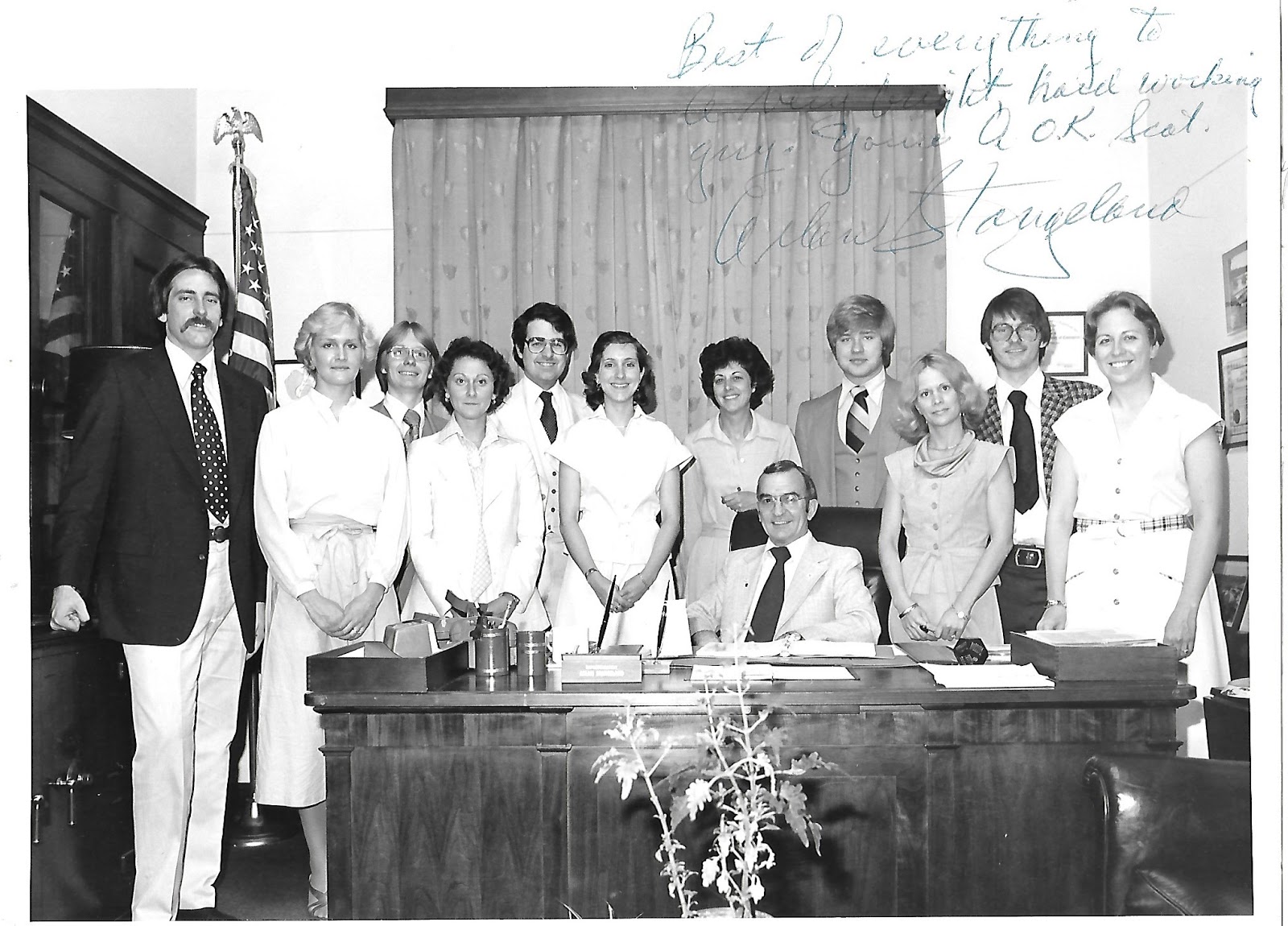
[Staff of Rep. Arlen Stangeland (R-MN) 1978.  Scot Faulkner is 5th from left]

"CONSTITUTING AMERICA" SERIES ON CONGRESSIONAL HISTORY

A bill becomes a law only through collaboration, communication, and teamwork.

Members of Congress are pulled in many directions. Members must be Members, which means they attend hearings, participate in legislation via debate and voting, and communicate with their constituents. Members, who want to remain Members, must be perpetual candidates, which means raising funds, working with their campaign team, involving themselves with national, state, and local officials within their political party, and engaging organized special interests that provide funds, endorsements, and resources. Members are increasingly Ambassadors to a sprawling government, meaning their offices are “embassies” representing the interests of their constituents to federal officials and guiding their constituents through the federal labyrinth to obtain government benefits, regulatory relief, and due process.

No one person can handle all these roles. That is why Congressional Staff exist.

Members during the first seventy years under the U.S. Constitution, performed their diverse duties themselves. The Federal government was small and legislative sessions were short.

Just before the American Civil War, the size, scope, and complexity of the Federal Government had grown to a point where full time staff began supporting Members. The first staff were attached to major committees. Many of these were clerical staff to take notes and help draft legislation. Even during the busy period of Post-Civil War Reconstruction and Westward expansion, such as 1867, the Congress only passed 30 bills and 41 resolutions a year.

By the end of the 19th Century Congress had only 146 staff members: 37 Senate personal staff, 39 Senate committee staff, and 62 House committee staff (37 of whom only worked during congressional sessions). In 1893, the House approved the first personal staff for its Members.

The Populist and Progressive movements ignited government regulation of America’s burgeoning economy. New federal agencies meant dramatic increases in spending and the need for vigorous Congressional oversight of Executive Branch activities.

Except for limiting government during the Administration of President Calvin Coolidge, the role, scope, and size of the federal activities grew rapidly and never stopped. Congress introduced, considered, and passed more and more laws facilitating this expansion. By the early 1970s over 26,000 legislative bills and resolutions were being introduced during each two-year Congress.

Congressional staff expanded to support Members. Members, torn by their multiple responsibilities, deferred increasingly to their staffs.

Today, approximately 14,000 employees work on House and Senate leadership, committee, and personal staffs.

Each Congress begins, on its first day of existence, with establishing its governing rules. This includes setting personal staff levels and authorizing a standard amount funding each office to pay that staff.

The personal staff of a Senator or Representative are people who take the lead in handling the multiple roles of each Member. Staff conduct “Case work” to help constituents receive the services, benefits, and due process they deserve. Receptionists welcome visitors and help them access special tours and events through the Nation’s Capital. Administrative and technical staff manage office operations and information resources. District staff provide similar services within the Members’ home area, including attending countless meetings with local officials and interest groups.

The heart of a Congressional staff is the legislative team. These individuals spend sometimes 100 hours a week carrying out the original purpose of representative government. A mix of young enthusiastic newcomers, fresh from college, work closely with seasoned professionals who may spend their entire careers working in Congress.

Ideally, a Senator’s or Member’s legislative team become the alter-ego of those they serve. They anticipate the Member’s needs. They become intimately knowledgeable of the issues most important to the Member and their constituents. As a Member gains seniority, the legislative team will grow with the Member and help them become a recognized leader on selected policies.

Legislative staff become the Member’s intellectual annex. They attend briefings, cultivate relationships with policy experts, and build their own collaborative networks among other Member staffs, lobbyists, and the media. They become invaluable in alerting the Member to opportunities and threats relating to the Member’s core interests and his or her’s constituents.

Legislative staff will collaborate with their network, including associates within Congressional leadership and committees, to manage the legislative process for their Member. At the basic level, legislative staff will “triage” pending legislation into its level of importance to the Member. This may include recommendations on how to vote on procedural motions and amendments, taking input from their Party’s leadership.

Legislation that is more important to a Member may require the legislative staff to draft amendments and speeches. The best staffers are ghostwriters, whose words so closely reflect the Member’s thinking and speaking, few will ever know where the staffers’ words end and the Members’ begin.

Ultimately, an issue requires the Member to take the initiative. The legislative staff will develop a strategy, which may include writing and introducing new legislation. At this level the legislative staff becomes a campaign team, mobilizing support from other Members, garnering endorsements and commitments from lobbyists and interest groups, engaging the media, and orchestrating hearings and media events to move the legislation forward.

It is no wonder that the most effective among the legislative staffers in Congress are highly sought after by outside interests and lobby groups. Such “super stars” can earn far more “on the outside” and some make the leap to the private sector.

Therefore, It is truly inspirational when a legislative staffer completes their career in Congress after many years of serving the Legislative Branch. They are the true “institutionalists” who maintain the culture of professionalism and pass their knowledge and commitment to the next generation.

[Scot Faulkner advises corporations and governments on how to save billions of dollars by achieving dramatic and sustainable cost reductions while improving operational and service excellence. He was the Chief Administrative Officer of the U.S. House of Representatives. He started his Congressional career as an intern for Rep. Don Young (R-AK), then served on the legislative staffs of Rep. Arlen Stangeland (R-MN) and Rep. John Ashbrook (R-OH). Faulkner later served on the White House Staff and as an Executive Branch Appointee.]

Thursday, April 19, 2018

NO ONE IS ABOVE THE LAW


CONSTITUTING AMERICA” SERIES ON CONGRESSIONAL HISTORY

Our U.S. Constitution (1787), and powers of the Legislative Branch, embody the distrust of concentrated power and establish mechanisms to hold that power in check. This concern for “sovereign over reach”, and the ways to prevent it, flow from the Charter or “Carta” signed on the field of Runnymeade in 1215.

On May 26, 1976, in a solemn ceremony at Westminster Hall in London, the leaders of the U.S. House of Representatives and Senate received a gold-embossed reproduction of the Magna Carta. On June 3, 1976, a second ceremony, in Washington, DC, installed the gold reproduction and the original Wyems copy of the Magna Carta in the Capitol Rotunda to celebrate America’s Bi-centennial.

While the original Magna Carta returned to England, the gold Magna Carta remains on permanent display in the Capitol. “Nothing could be more symbolically important to the people of the United States,” stated Speaker Carl Albert during the ceremony.

Why is the Magna Carta so firmly linked to America’s Legislative Branch? How are the underlying principles of the Magna Carta embodied in the operations of the Congress?

Winston Churchill, in his masterpiece, “A History of the English Speaking Peoples”, explained, “Throughout the document [Magna Carta] it is implied that here is a law which is above the King and which even he must not break. This reaffirmation of a supreme law and its expression in a general charter is the great work of Magna Carta; and this alone justifies the respect in which men have held it.”

England’s King John was humbled by barons at Runnymeade on June 15, 1215. The King had over reached as an aspiring despot. The barons had the military force, and the political will, to assert there were limits to even a King’s power. Magna Carta was the contract that re-established the rule of law and re-asserted certain rights for the ruling class. This included forbidding the King from compelling certain actions, and prevented him from imposing punishments and fines except through due process within narrowly defined cause.

England would expand upon these basic principles as Parliament gradually replaced the Monarchy in governing the nation. This process required a Civil War (1642-1647), the beheading of King Charles I (1649), and the deposing of King James II (1688).

America’s Revolution (1775-1781) and Declaration of Independence (1776) arose from a similar concern over King George III’ssovereign over reach”. 

Magna Carta’s revolutionary concept of holding the King accountable for a breach of contract with England’s nobles was broadened in the Declaration of Independence. Thomas Jefferson established rights above Common Law and Medieval precedents with the famous phrase, “We hold these truths to be self-evident, that all Men are created equal, that they are endowed by their Creator with certain unalienable Rights.”

The U.S. Constitution put this broader interpretation of Magna Carta into practice. Alexander Hamilton, James Madison, and John Jay, writing in Federalist 84, explain:

It has been several times truly remarked that bills of rights are, in their origin, stipulations between kings and their subjects, abridgements of prerogative in favor of privilege, reservations of rights not surrendered to the prince. Such was MAGNA CARTA, obtained by the barons, sword in hand, from King John...Here [in America], in strictness, the people surrender nothing; and as they retain everything they have no need of particular reservations. “WE, THE PEOPLE of the United States, to secure the blessings of liberty to ourselves and our posterity, do ordain and establish this Constitution for the United States of America.” Here is a better recognition of popular rights.”

The U.S. Constitution builds upon centuries of Parliamentary precedent by placing the power of legislation, and the funding of government operations, clearly in the hands of the Legislative Branch. This is why Article I begins, “All legislative Power herein granted shall be vested in a Congress of the United States...”

It is not a coincidence that Article I, the Legislative Branch, is more than double the size of Article II, the Executive Branch, in defining power and authority (2,282 words to 1,023 words). The final section on the Executive Branch establishes Congress’ ultimate sanction against “sovereign over reach”:

Section. 4. The President, Vice President and all Civil Officers of the United States, shall be removed from Office on Impeachment for and Conviction of, Treason, Bribery, or other high Crimes and Misdemeanors.

From the very first, the Legislative Branch asserted its role in limiting Executive Power. Senators quickly and effectively embraced the limitation of the President to appoint only with the “the Advice and Consent of the Senate” (Article II, Section 2).

The first test was rejecting President George Washington’s appointment of Benjamin Fishbourn to be a customs collector. On August 5, 1789, President Washington strode unannounced into Federal Hall in New York City, then the Capitol Building. Vice President John Adams allowed Washington to sit in the presiding officer’s chair. The President, according to Ron Chernow’s definitive biography on Washington, “proceeded to unbraid the twenty-two members of the Senate, demanding to know why they spurned his appointee.”

Senator Ralph Izard of South Carolina spoke for the institution asserting that “the Senate had no obligation to explain its reasoning to the President”. It was the last time Washington, or any other President, entered a Legislative Chamber without permission.

Battles over appointees, spending, and legislation have defined the balance of power between the Congress and the President. In each encounter, Congress has ultimately reaffirmed its power to limit “sovereign over reach”. This has included censuring President Andrew Jackson (1834) and impeaching Presidents Andrew Johnson (1868), Richard Nixon (1974), and Bill Clinton (1998-1999).

The “Lincolnia” original of the Magna Carta was displayed at the New York World’s Fair in 1939. It remained safe in America during World War II, even being stored in the vault of Fort Knox after the Pearl Harbor attack. 

America kept the physical Magna Carta safe, and kept Magna Carta’s revolutionary legacy of holding power accountable.

[Scot Faulkner advises corporations and governments on how to save billions of dollars by achieving dramatic and sustainable cost reductions while improving operational and service excellence. He served as the Chief Administrative Officer of the U.S. House of Representatives. He also served on the White House Staff, and as an Executive Branch Appointee.]

Tuesday, June 16, 2015

Stopping Obama's Usurpation of Advice & Consent


This also appears at: http://www.constitutingamerica.org/blog/stopping-the-usurpation-of-advise-and-consent-guest-essayist-scot-faulkner/; https://www.linkedin.com/pulse/stopping-obamas-usurpation-advice-consent-scot-faulkner?trk=mp-reader-card


June 28, 2014 is an historic day in thwarting Presidential over-reach. On that day the U.S. Supreme Court unanimously ruled President Obama’s recess appointments unconstitutional. NLRB versus Noel Canning, ET AL was a rare instance when the Judicial Branch acted as referee and reset the balance of power between the Executive and Legislative Branches.


The case centered on Noel Canning challenging a February 8, 2012 National Labor Relations Board (NLRB) decision on the grounds that its quorum only existed with the presence of invalid recess appointments. Noel Canning’s attorney argued that Obama’s ap­pointments were invalid because the 3-day adjournment between Congressional sessions was not long enough to trigger the Recess Ap­pointments Clause.


On January 25, 2013, a three-judge panel of the U.S. Court of Appeals for the D.C. Circuit struck the first blow against President Obama’s over reach by unanimously agreeing with Canning and ruling that the three recess appointments to the NLRB on January 4, 2012 were unconstitutional.


The Appeals Court asserted that the circumstance that would allow a President to make “Recess Appointments” under Article II, Section 2 of the U.S. Constitution did not exist, because the Congress was in Pro Forma Session, not in a formal recess.


The Constitutional Convention of 1787 established two coequal chambers within the Legislative Branch.  One aspect of this balance is that:
Neither House, during the Session of Congress, shall, without the Consent of the other, adjourn for more than three days, nor to any other Place than that in which the two Houses shall be sitting. [Article 1, Section 5, Clause 4]


The formal end of a Congress is when the Legislative Branch adjourns “Sine Die” (from the Latin “without day”) meaning “without assigning a day for a further meeting or hearing”.  The Twentieth Amendment to the Constitution also sets a formal start and end time for each Congress.


The most complex consequence of Clause 4 relates to when Congress takes a recess and when it adjourns. A recess is a temporary halt to activity on the floor. Everything stops, and when the recess ends, the chamber resumes from where it left off. A recess might last 10 minutes or it might last weeks. The length of time does not matter. An adjournment is a formal end to business in the chamber, and upon return the chamber does not resume from where it left off. Just like a recess an adjournment can be for one minute or for three weeks.


Any formal break in Legislative Branch activity opens the door for a President to take certain actions. This includes making appointments which require Senate confirmation. Congressional leaders of both parties have devised ways to avoid inadvertently unleashing Presidential activism.


The Congress can take a break from legislative activity, and still avoid a formal recess or adjournment, by meeting in a “pro forma” session. Pro forma means “for the sake of formality”. In recent years pro forma sessions have prevented Presidents from making recess appointments, and in the case of President George W. Bush in 2008, deprived him calling a special session to reauthorize the Protect America Act and the Foreign Intelligence Surveillance Act.


As long as a Member convenes either the House or Senate to formally open and close a session there is no recess or adjournment. Members sometimes compete to see how fast they can conduct a pro forma session. The record is currently held by Senator Jack Reed of Rhode Island who completed the task in 12 seconds.


Obama’s January 2012 appointments were designed to dramatically expand his appointment authority by asserting his recess-appointment power as a “safety valve” against Senatorial “intransigence.” [1]
The Supreme Court unanimously declared the President lacked the authority to make those appointments. [2]


Justice Breyer delivered the opinion of the Court and quoted from the Federal Papers,  ”the need to secure Senate approval provides “an excellent check upon a spirit of favoritism in the President, and would tend greatly to preventing the appointment of unfit characters from State prejudice, from family connection, from personal attachment, or from a view to popularity.” [3]


Breyer further wrote, “If a Sen­ate recess is so short that it does not require the consent of the House, it is too short to trigger the Recess Appoint­ments Clause. See Art. I, §5, cl. 4. And a recess lasting less than 10 days is presumptively too short as well”. [4] He dismissed the counter arguments of Obama’s Solicitor General as not, “either legally or practically appropriate”. [5]


Justice Scalia wrote a Concurrence that went further in assailing Obama’s attempt to nullify the Senate’s role in the appointment process [6].  Scalia exposed Obama’s “untenably broad interpretation” of Presidential power. [7] He also defined the Senate’s role in advice and consent on Presidential appointments “as a critical protection against “‘despotism,’ Freytag, 501 U. S., at 883”. [8]


The Concurrent Opinion was unprecedented in raising serious concerns over President Obama’s “aggrandizing the Presidency beyond its constitutional bounds and undermining respect for the separation of powers”. [9] It also challenged Obama’s rationale, “I can conceive of no sane constitutional theory…requiring us to defer to the views of the Executive Branch”. [10]


Justices Scalia, Thomas, Roberts, and Alito stood firm against Obama’s power grab by embracing the founding principles of America, “the limitation upon the President’s appointment power is there not for the benefit of the Senate, but for the protection of the people”. [11]


Scot Faulkner served as Chief Administrative Officer of the U.S. House of Representatives and as a Member of the Reagan White House Staff.  He earned a Master’s Degree in Public Administration from American University, and a Bachelor’s Degree in Government from Lawrence University


NOTES:
[1] Tr. of Oral Arg. 21; page 74. http://www.supremecourt.gov/opinions/13pdf/12-1281_mc8p.pdf
[2] NLRB versus Noel Canning, ET AL; No. 12–1281. Argued January 13, 2014—Decided June 26, 2014; 573 U. S. ____ (2014); 705 F. 3d 490, affirmed; Page 41.
[3] Alexander Hamilton, The Federalist No. 76, p. 513 (J. Cooke ed. 1961).
[4] NLRB versus Noel Canning, ET AL; No. 12–1281. 573 U. S. ____ (2014); page 26.
[5] Ibid; page 43.
[6] Ibid; page 60. Scalia jointed by Justices Thomas, Roberts, and Alito.
[7] Ibid; page 61.
[8] Ibid; page 70.
[9] Ibid; page 108.
[10] Ibid; page 106.
[11] Ibid; page 107.

Thursday, March 10, 2011

Origins of the Congressional Record


This article was published in Constituting America

Article 1, Section 5, Clause 3


Each House shall keep a Journal of its Proceedings, and from time to time publish the same, excepting such Parts as may in their Judgment require Secrecy; and the Yeas and Nays of the Members of either House on any question shall, at the Desire of one fifth of those Present, be entered on the Journal.

Documenting public processes have been part of governing since the rise of early civilizations. From the Sumerians in 2500 BC, to ancient Egypt and Babylon, governments have kept journals of their actions and public meetings.

The Founding Fathers knew the importance of maintaining a Journal of Proceedings from the English House of Commons. James Wilson, a member of the Committee on Detail which compiled the provisions of the draft Constitution, was a follower of the great British parliamentary scholar Sir William Blackstone. He quoted Blackstone’s Oxford 1756 lectures, which underscored the importance of a public record for holding officials accountable, “In the House of Commons, the conduct of every member is subject to the future censure of his constituents, and therefore should be openly submitted to their inspection.”

The Constitution’s “Journal of Proceedings” wording flows from the Articles of Confederation. In March 1781 the Continental Congress approved the following provision: “…and shall publish the Journal of their proceedings monthly, except such parts thereof relating to treaties, alliances or military operations, as in their judgment require secrecy; and the yeas and nays of the delegates of each state on any question shall be entered on the Journal, when it is desired by any delegate; and the delegates of a state, or any of them, at his or their request shall be furnished with a transcript of the said Journal, except such parts as are above excepted, to lay before the legislatures of the several states.”

But what is the Journal? Every day the Congress approves the “Journal” of the previous session. This is the official outline of actions taken during the previous meeting of each Chamber, like a set of minutes. It is codified in Section 49 of Thomas Jefferson’s 1812 Parliamentary Manual that governs Congressional operations. Members of Congress do not approve the Congressional Record. That transcript of House and Senate proceedings has a colorful history.

The transcribing of Congressional debate was begun by private publishers. House and Senate proceedings, roll calls, debates, and other records were recorded and published in The Debates and Proceedings in the Congress of the United States (1789–1824), the Register of Debates in Congress (1824–1837), and the Congressional Globe (1833–1873).

During the 36th Congress [December 5, 1859 to March 3, 1861] it was decided that federal funds should be used for transcribing Congressional proceedings and that the Government Printing Office should publish the verbatim record. The Congressional Globe was contracted to provide stenographers in the House and Senate Chambers. In 1873, the Globe’s contract was not renewed, and the Congressional Record was born. The Clerk of the House and the Secretary of the Senate now oversee documenting and transcribing the verbatim proceedings of their respective chambers.

The Congressional Record is still not an accurate verbatim transcript of the proceedings and debate for each Chamber. Members routinely insert remarks and documents after the fact. While these “revised and extended remarks” help Members explain their actions, they are considered “secondary authorities” when it comes to determining legislative intent. Secondary authorities are generally afforded less weight than the actual texts of primary authority during Judicial review.

The chronicling of Congress has come almost full circle. While the Congressional Record remains the official transcript of proceedings, CSPAN, a nonprofit private entity, provides live coverage of each Chamber. The cameras are owned and maintained by the Architect of the Capitol, while their operations and broadcasts are operated by staffs of the Chief Administrative Officer in the House and the Secretary of the Senate. CSPAN receives the signal and airs it on its various cable television channels. Live House broadcasting began on March 19, 1979 while Senate coverage commenced on June 2, 1986.