Showing posts with label Pain Management. Show all posts

Friday, February 14, 2025

LIGHTING THE WAY TO A HEALTHIER AMERICA


The Make America Healthy Again (MAHA) movement is now national policy with Trump establishing the MAHA Commission and Robert F. Kennedy, Jr. as the Secretary of the Department of Health & Human Services (HHS). 

Americans are universally concerned about their health, but well-financed and entrenched interests are thwarting MAHA.  Big Pharma spends $400 million a year on lobbying and contributes $90 million each election cycle.  Big food spends $130 million a year on lobbying and contributes $42.5 million each election cycle. 

Funding and lobbying by Big Pharma and Big Food support the Medical Establishment’s unwillingness to embrace new medical approaches.  This inertia plagues American healthcare.

American food is harming us. Many colleagues echo my own overseas experience where the food tastes better and we lose weight, even when eating heartily.

Medical professionals are increasingly using “Healthspan” instead of “Lifespan” to define health.  Why live into your 90s if you lose your mobility and brain function. 

Care based on holistic thinking and patient-centric approaches are core elements of “Healthspan”.

MAHA is mobilizing people and policies to improve our diet and lifestyle, such as more exercise.  It promotes alternative approaches to healing and wellness.

Historically, the Medical Establishment has embraced dubious methods that proved ineffective.  First, they “cast out” demons.  Then they “bled out” humors and poisons. Patients, including pregnant women, were deprived fresh air and sunlight until Florence Nightingale prevailed over military bureaucrats during the Crimean War. 

Cutting on patients and drugging them are the current standards of care.  Certain circumstances warrant these actions, but a growing mountain of evidence is showing there is a better way to treat many conditions.

Light is the key to extending our “Healthspan.”

Just as Nightingale advocated, light heals.  Our cellular mechanisms are similar to plants.  We turn color when exposed to sunlight.  We need the vitamin D that sunlight provides.

The sub-atomic process that turns nutrients, including light, into energy for our cells is identical for plants and animals.

Late Twentieth Century scientists discovered that taking the red and near-infrared part of the light spectrum, and increasing its intensity, restores cellular function.  This process, known as Photobiomodulation (PBM), is increasingly accepted for health and wellness.

The first institutional use of PBM was to prevent the side-effects of chemotherapy in cancer patients.  Chemotherapy causes sores in the mouth and throat.  In the worst cases, these sores turn into Oral Mucositis, making the patient unable to swallow.  Feeding tubes and suspension of cancer treatment follows, sending the patient into a fatal tailspin.

PBM prevents the side-effects of chemotherapy.  It is so safe and effective that it is now the standard of care in most cancer centers.  St Jude uses a popsicle shaped device for delivering PBM into their young patients’ mouths. 

Photobiomodulation

PBM is not only safe and effective, it’s cost-effective.  Using PBM to prevent chemotherapy side-effects reduces the overall cost of cancer treatment by 70 percent per patient.

PBM reduces inflammation by unblocking the sub-atomic processes within the cell. This unblocking effectively manages pain.  This is so effective that in 2022, the Center for Disease Control (CDC) recommended PBM as the preferred alternative to Opioids as part of their revised Opioid Prescription Guidelines. 

CDC Clinical Practice Guideline for Prescribing Opioids for Pain — United States, 2022 | MMWR

51 million Americans suffer from chronic pain.  Annually, over 100,000 die of drug use.  Over 2 million struggle with Opioid Use Disorder (OUD). PBM solves these issues.

By restoring cell function, PBM accelerates the body’s ability to heal wounds and generate new skin tissue.  Patients suffering from burns, wounds, and skin ulcers heal months faster, leaving no scarring.

As Americans age and become diabetic, foot ulcers occur and, when treated using traditional techniques, usually lead to amputation.  PBM prevents amputation and restores functionality.

Areas of PBM Study - PBM Foundation

The greatest expansion of PBM clinical evidence is treating neurological conditions.

375,000 veterans have chronic conditions arising from battlefield blast injuries.  Traumatic Brain Injury (TBI) is linked to Post Traumatic Stress Disorder (PTSD) and to a higher susceptibility for having Parkinson’s. Veterans’ hospitals in Boston, Salt Lake City, and Denver conducted extensive clinical studies using PBM to successfully treat these conditions. 

In 2019, their dramatic results led the VA’s Center for Compassionate Care Innovation (CCCI) to recommend PBM to treat Traumatic Brain Injuries (TBI), Chronic Traumatic Encephalopathy (CTE), and Post-Traumatic Stress Disorder (PTSD). 

Center for Compassionate Care Innovation - National Center for Healthcare Advancement and Partnerships

Over 100 million patients have used PBM in clinical settings.  Millions more use PBM, or “red light” devices, in their homes.  There have been no documented side-effects. The American military integrates PBM into warfighter conditioning.  Around the world, major athletic teams use PBM for conditioning, performance improvement, and recovery.  In 2016, the International Olympic Committee (IOC) approved PBM use in competition.

The Food and Drug Administration (FDA) has been clearing PBM devices for decades. Devices are inexpensive, simple to use, and only take minutes per dose.

Photobiomodulation (PBM) Devices - Premarket Notification [510(k)] Submissions | FDA

So why isn’t Photobiomodulation therapy a common medical option?


Friday, August 19, 2022

THE FUTURE OF LIGHT THERAPY


Scot Faulkner spoke about the science and application of Photobiomodulation (PBM) - "red-light therapy" to the Annual Meeting of Doctors for Disaster Preparedness in Las Vegas.

Photobiomodulation: Innovative Treatment for Pain, Wounds, and Brain Injury. Scot Faulkner (rumble.com)


Tuesday, November 30, 2021

LIGHT THERAPY SHINES THROUGH


[Left to Right: Rep. Alex Mooney (R-WV); Rep. Jim Hagedorn (R-MN), 
Dr. Tara Schwetz (White House)]

[Published in Newsmax]

Light Therapy Shines Through | Newsmax.com

Rapidly mainstreaming breakthrough medical research, sometimes called "bench to bedside," has become a bipartisan priority. The rapid development and dissemination of COVID-19 vaccines established a new focus on how lives can be saved and improved if regulatory pathways, research resources, and the medical professional acceptance were better aligned.

Dr. Tara Schwetz, a senior member of the President's Office of Science and Technology, is driving the establishment of the new Advanced Research Projects Agency for Health (ARPA-H). Legislation to establish and fund ARPA-H is now moving through Congress.

This new agency is patterned after the Defense Department's DARPA, the "gold standard" for creative, paradigm-busting research and application.

One of the premiere examples of a paradigm-busting breakthrough medical technology is Photobiomodulation (PBM), also known as red light therapy.

PBM's effectiveness and future were recently showcased when scientists and practitioners presented their latest research to leaders from research institutions, research hospitals, cancer clinics, and medical schools at PBM2021.

Dr. Schwetz joined members of Congress as a keynote speaker to address scientists and medical professionals from 20 countries at the PBM2021 Global Conference on the importance of innovative medical technology.

PBM is a noninvasive, FDA cleared, medical technology that directs red and near-infrared light into mitochondria to restore normal cell function and reduce inflammation. It is a natural process aiding a natural process.

PBM has been used in over 100 million patient treatments without any documented side effects. PBM's role in speeding recovery and reducing side-effects from cancer treatments is documented as reducing the cost of care by up to 73%.

PBM therapy is successfully helping veterans with managing pain, treating neurological conditions, and speeding wound healing throughout the Veterans Integrated Services Networks (VISNs), including the Martinsburg VA Medical Center, the VA Boston Healthcare System, the Salt Lake City VAMC, and the Jesse Brown VA Medical Center in Chicago.

PBM prevents the painful side effects of cancer chemotherapy and radiotherapy. The Multinational Association for Supportive Care in Cancer (MASCC) recommends PBM as the standard of care for preventing oral mucositis. PBM is now preventing cancer therapy side effects at leading cancer centers, including St. Jude's Children Research Hospital, MD Anderson Cancer Center, and the Dana-Farber Cancer Institute at Harvard

PBM therapy's efficacy is supported by over 800 randomized clinical trials (RCTs) and 8,000 research studies, many published in leading scientific journals, including the Journal of the American Medical Association (JAMA) and The Lancet.

There are currently over 190 active PBM clinical trials. Awareness of, and support for, PBM therapy is expanding thanks to formal presentations to policy leaders on its benefits for pain management, wound healing, and preventing cancer therapy side effects.

These presentations ranged from congressional briefings to testimony before the Office of National Drug Control Policy (ONDCP), federal Pain Management Best Practices Inter-Agency Task Force, the Centers for Disease Control's (CDC) Board of Scientific Counselors, and the Center for Clinical Standards and Quality at the Centers for Medicare & Medicaid Services (CMS).

Photobiomodulation's "light revolution" hopes to follow in the path blazed by other important medical technology that went from exotic to commonplace. MRIs and sonograms are just two breakthrough technologies that overcame initial resistance to become integral to maintaining our health.

Tuesday, May 14, 2019

ENLIGHTENING OUR FUTURE

                         Dr. Hanli Lui demonstrating PBM Helmet at Boston Veterans Health Center

Published on Newsmax

The United Nations International Day of Light, on May 16, commemorates the first successful use of a laser.  This year, there is much to celebrate.

Awareness and acceptance of Photobiomodulation (PBM) Therapy have witnessed historic strides over the last twelve months, saving lives and bringing hope to millions.

PBM Therapy is the process where infra-red and near infrared light, when directed at parts of the body with the right intensity, stimulates mitochondria to repair and restore cell function and reduce inflammation.  It is a natural process aiding a natural process within our body’s 37 trillion cells. 

PBM Therapy’s efficacy is now supported by over 700 Randomized Clinical Trials (RCTs) and 4,000 lab research studies, many published in leading scientific journals, including the Lancet and the British Medical Journal. 

During this past year, evidence of PBM Therapy’s viability as a pain treatment option was presented at medical conferences, to the U.S. Congress, and to the White House as a potential solution to the opioid crisis.

PBM Therapy’s use is rapidly expanding in three important medical areas.

On May 9, 2019, Admiral Brett Giroir, Assistant Secretary for Health at the Department of Health and Human Services, opened the Pain Management Best Practices Inter-Agency Task Force meeting by declaring, “We cannot solve America’s Opioid Crisis without solving America’s Pain Crisis”. 

A National Institutes of Health (NIH) study estimated that over 100 million Americans suffer from chronic pain.  This is costing them $600 billion a year in medical treatments. Science Daily and the American Academy of Pain Medicine (AAPM) documented America’s annual costs of chronic pain at $635 billion, including lost productivity. Those turning to opioids and other pain medications, legal and illegal, encounter death and disabilities, adding another $504 billion a year to the cost of pain in America, according the Council of Economic Advisors.


PBM Therapy’s role in effectively managing pain and reducing the need for opioids, is being embraced by an expanding number of policy officials, scientists, and healthcare professionals.  The legions of patients whose lives have been saved using light therapy are building the case for adopting this innovative technology. 

The Opioid Crisis Response Act (OCRA) was signed into law on October 24, 2018.  It mandated the federal government assess using technology solutions to manage pain.

PBM Therapy’s role in treating and preventing the terrible side effects of cancer chemotherapy and stem cell transplants is being officially recognized and accepted.  The University of Pittsburgh Medical Center has successfully treated 850 cancer patients to significantly reduce oral mucositis, one of the worst side effects of cancer treatment.  Patients who had to suspend cancer treatment to recover their ability to digest food, are now progression free survivors thanks to PBM Therapy.   St. Jude’s Children’s Medical Research Hospital is currently implementing PBM Therapy for its pediatric oncology patients.

This June, the Multinational Association of Supportive Care in Cancer (MASCC) is officially recommending PBM Therapy as the Standard of Care treatment for side effects relating to high dose chemotherapy, radiotherapy, and stem cell transplants.  This is the first international endorsement of PBM Therapy’s effectiveness.

PBM Therapy is becoming the treatment of choice to help America’s veterans.

PBM Therapy is successfully helping Veterans at the Boston Veterans Healthcare System.  The ground breaking work of Dr. Marnie Naeser, has documented PBM Therapy’s effectiveness in treating Traumatic Brain Injury (TBI), Post Traumatic Stress (PTS), and Parkinson’s Disease.

Based upon the results in Boston, the Jesse Brown VA Medical Center in Chicago, and the Martinsburg VA Medical Center in West Virginia, are implementing similar programs for treating pain, reducing opioid use, and treating neurological conditions. They, and other Veterans’ Medical Centers, are assessing PBM Therapy for improving wound healing.

On April 24, 2019, the television show “Seal Team” featured a veteran suffering from combat-related Traumatic Brain Injury (TBI) asking a Veteran’s Hospital doctor about using “Photobiomodulation” to treat his condition.  This was PBM’s first popular culture reference. 

PBM Therapy is starting to move beyond the early-adopter circles of medical research to become an evidence-based treatment option for mainstream healthcare providers.  The coming years promise further dramatic advances in research and acceptance.  

The Day of Light is heralding the Age of Light.

Thursday, January 17, 2019

ENDING OPIOIDS BY PHOTOBIOMODULATION

GUEST CONTRIBUTOR – James D. Carroll
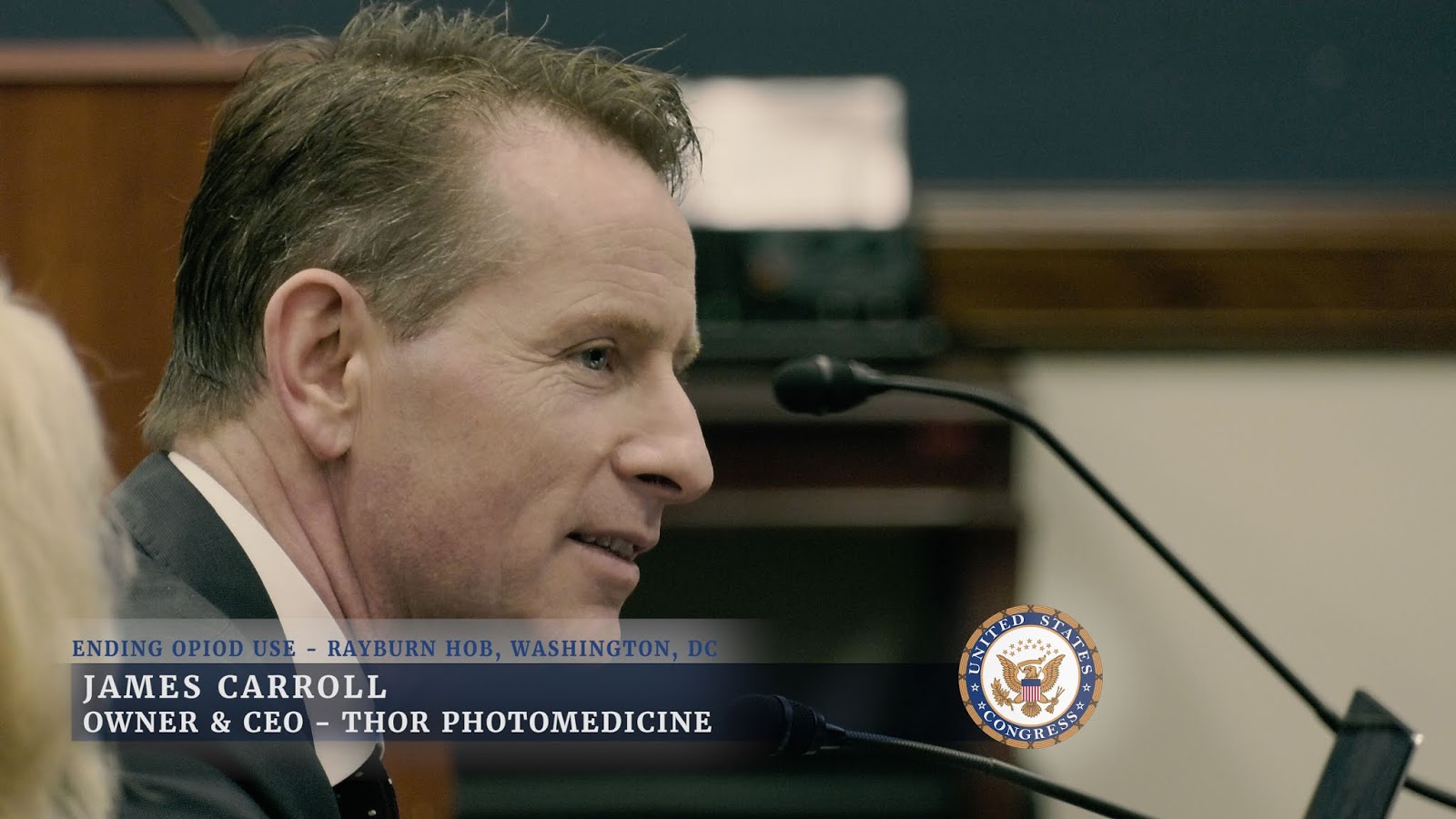
Congressional Briefing on Ending Opioid Use by
treating pain using Photobiomodulation
Rayburn House Office Building
October 11, 2018

Mr. Chairman, members of Congress ladies and gentlemen. I am James Carroll, CEO and founder of THOR Photomedicine.

I am sure are all too aware there is an opioid crisis. A hundred million adults in the United States are affected by chronic pain and $600 billion a year is spent on in health care, direct health care costs and lost productivity because of pain.

49,000  people from opioids in 2017, 19,000 of which were from prescribed opioids for pain relief.

So we believe that Photobiomodulation therapy can help reduce the prescribing of opioid medication for pain relief and we wish to draw attention to the Congress and health care policymakers, NIH and CMS, about this potentially valuable tool.

I will start at the beginning, what is photobiomodulation therapy?

Some of you may have seen a TV show in the past called Star Trek.

On Star Trek when somebody was injured they would be taken to sickbay, and the doctor would get out a laser beam and aim it at the injury, and the patients would heal instantly, well that is photobiomodulation.

It is not as fast as on TV, we don't heal people instantly, but you get the idea, we shine a special kind of light on people, and they get better more quickly.

So what is this Photobiomodulation?

Photobiomodulation (PBM) Therapy previously known as Low-Level Laser Therapy (LLLT) is the application of monochromatic light which means light of one color, and if we have light at the right color (or to use the technical phrase the right wavelength) and if the light is of the right intensity, and if we aim it in the right place, for the right amount of time, then we can increase the speed of tissue repair, we can reduce inflammation and edema, and we can induce an analgesic effect.

Most of the published clinical evidence is on musculoskeletal pain (sprains and strains and creaky joints), but there is also evidence for its effect on neuropathic pain, non-healing wounds and oral mucositis a severe side effect of chemotherapy and radiotherapy for which opioids are often prescribed.

Treatments look like this, usually directly to the skin or an injury and it can be intraoral, it can be extraoral, we can do some remote treatments as well.


Photobiomodulation (PBM) is not a heat therapy, the effects on the body are more like photosynthesis in plants because humans and animals will photosynthesize, and you know this already but you not have thought about it before, but you know when we go out in the sun we change color, that is a form of photosynthesis, and we use light to help synthesize vitamin D, and you may know that in hospitals they treat premature babies with blue light to prevent neonatal jaundice, and you may know that dermatologists  use ultraviolet light for treating psoriasis and vitiligo, so we should not be surprised if light has some other effects on the body.

Normally you and patients and many doctors will associate lasers in medicine with cutting and cauterizing tissue. The good news is that not all lasers are dangerous,  some of them are more dangerous than others and that's because there are different classes of lasers. 


Class one lasers are inherently safe, they are used in supermarkets for reading barcodes and nobody gets hurt. The medical lasers you are probably thinking of are Class 4 lasers, they're the ones that have a thermal effect.

PBM Therapy uses Class 3B lasers, they have no harmful effects on skin or clothing but they are potentially hazardous to the eyes. So everybody should be wearing laser safety glasses when PBM lasers are being used, but PBM Therapy also utilizes light-emitting diodes (LEDs), they have some similar qualities to lasers but they also have they have no harmful effects and are usually safe for the eyes.

For the sake of this presentation, we are going to assume that lasers and LEDs do the same thing because mostly they do, we do not have time today to explain when it is best to use lasers or when it might be best to use LEDs.

There are 500 randomized placebo control clinical trials published on PBM and yet most people in medicine have never even heard of it.

There are over 4,000 laboratory studies looking at the mechanism of action and dose-response, and about thirty peer-reviewed research papers are published every month in this field.

Some of the popular medical applications of PBM Therapy include: hard to heal wounds (such as diabetic foot ulcers, venous ulcers and pressure sores), musculoskeletal pain such as tendinopathies, neck pain (as reviewed here in The Lancet).


Reduced use of opioids for Post-operative pain. Postherpetic Neuralgia one of the worst pains that you can get. It’s chronic persistence hypersensitivity and in some patients and its really severe,  people can’t wear shirts and they can’t lie down, they can’t bear to be touched, it drives some people to suicide. At the end of the study 95% of patients discontinued all medication. At 6-month follow-up 80% maintained their reduction in pain.


Oral mucositis is a painful, debilitating side effect of high dose chemotherapy and radiotherapy often requiring opioids for pain control. Thirty-three clinical trials (RCTs) have shown PBM Therapy to be effective in reducing the incidence and severity of oral mucositis.


The Multinational Association for Supportive Care in Cancer (MASCC) recommend the use of PBM Therapy for treating oral mucositis, and in the United Kingdom the National Institute of Health and Care Excellence  (NICE) recommend cancer patients receive this treatment in the UK National Health Service (NHS).


It has been shown in one long term follow-up Oral Mucositis study on 108 patients followed up to 8 years that the active PBM threated group had better long term (cancer) progression-free survival than those in the placebo group.

How can one medicine treat so many different diseases?

You know you shouldn’t believe anything that appears to do everything. PBM does not do everything, it treats one thing and it treats it very well, it is something scientists call it Reactive Oxygen Species (ROS), doctors call it Oxidative Stress, and most patients would call them Free Radicals

Light has a profound effect on the production of ROS, but where do they come from? They come from mitochondria. So what are mitochondria? Well, mitochondria are often called the powerhouses of the cell. 


The short story is; when we're sick, injured, stressed or just old, our cells tend to be low on ATP,  high in oxidative stress, when we put PBM Therapy into patients it tips the balance in favor of more ATP and less oxidative stress, and under these circumstances patients get better and more quickly.


PBM Therapy is safe and effective for a wide range of medical conditions where drugs and surgery have failed. It is time for this proven procedure to be considered as a first line medical treatment.

This is not just another form of pain relief, it actually helps people heal.

For more information visit: www.CONGRESSPBM.com


James Carroll has been working on Photobiomodulation for over 30 years (since1987). He is a recognized authority on Photobiomodulation dose, dose rate effects and the measurement and reporting of parameters. He has written or co-authored 18 published academic papers and three books on Laser Photobiomodulation. His most recent appointments include: Biomedical Optics Society conference chair, Fellow of The Royal Society of Medicine, and Editorial Board of Photomedicine and Laser Surgery. He also served on the World Association for Laser Therapy and the North American Association for Laser Therapy. James recently presented Photobiomodulation to the United Nations Global Health Impact Forum.