
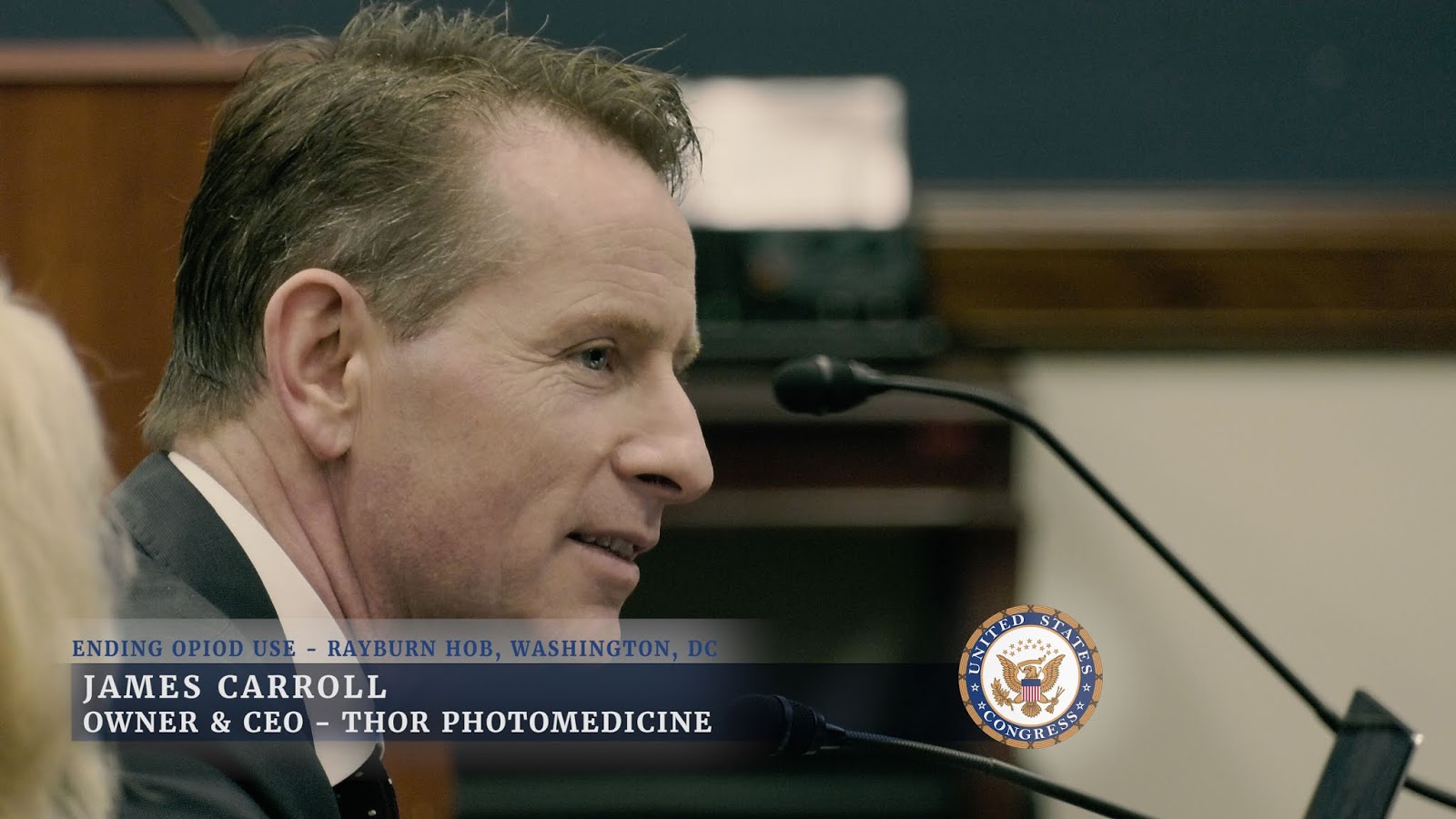
GUEST
CONTRIBUTOR – James D. Carroll
Congressional
Briefing on Ending Opioid Use by
treating
pain using Photobiomodulation
Rayburn
House Office Building
October
11, 2018
Mr.
Chairman, members of Congress ladies and gentlemen. I am James
Carroll, CEO and founder of THOR Photomedicine.
I
am sure are all too aware there is an opioid crisis. A hundred
million adults in the United States are affected by chronic pain and
$600 billion a year is spent on in health care, direct health care
costs and lost productivity because of pain.
49,000
people from opioids in 2017, 19,000 of which were from
prescribed opioids for pain relief.
So
we believe that Photobiomodulation therapy can help reduce the
prescribing of opioid medication for pain relief and we wish to draw
attention to the Congress and health care policymakers, NIH and CMS,
about this potentially valuable tool.
I
will start at the beginning, what is photobiomodulation therapy?
Some
of you may have seen a TV show in the past called Star Trek.
On
Star Trek when somebody was injured they would be taken to sickbay,
and the doctor would get out a laser beam and aim it at the injury,
and the patients would heal instantly, well that is
photobiomodulation.
It
is not as fast as on TV, we don't heal people instantly, but you get
the idea, we shine a special kind of light on people, and they get
better more quickly.
So
what is this Photobiomodulation?
Photobiomodulation
(PBM) Therapy previously known as Low-Level Laser Therapy (LLLT) is
the application of monochromatic light which means light of one
color, and if we have light at the right color (or to use the
technical phrase the right wavelength) and if the light is of the
right intensity, and if we aim it in the right place, for the right
amount of time, then we can increase the speed of tissue repair, we
can reduce inflammation and edema, and we can induce an analgesic
effect.
Most
of the published clinical evidence is on musculoskeletal pain
(sprains and strains and creaky joints), but there is also evidence
for its effect on neuropathic pain, non-healing wounds and oral
mucositis a severe side effect of chemotherapy and radiotherapy for
which opioids are often prescribed.
Treatments
look like this, usually directly to the skin or an injury and it can
be intraoral, it can be extraoral, we can do some remote treatments
as well.

Photobiomodulation
(PBM) is not a heat therapy, the effects on the body are more like
photosynthesis in plants because humans and animals will
photosynthesize, and you know this already but you not have thought
about it before, but you know when we go out in the sun we change
color, that is a form of photosynthesis, and we use light to help
synthesize vitamin D, and you may know that in hospitals they treat
premature babies with blue light to prevent neonatal jaundice, and
you may know that dermatologists use ultraviolet light for
treating psoriasis and vitiligo, so we should not be surprised if
light has some other effects on the body.
Normally
you and patients and many doctors will associate lasers in medicine
with cutting and cauterizing tissue. The good news is that not all
lasers are dangerous, some of them are more dangerous than
others and that's because there are different classes of lasers.

Class
one lasers are inherently safe, they are used in supermarkets for
reading barcodes and nobody gets hurt. The medical lasers you are
probably thinking of are Class 4 lasers, they're the ones that have a
thermal effect.
PBM
Therapy uses Class 3B lasers, they have no harmful effects on skin or
clothing but they are potentially hazardous to the eyes. So everybody
should be wearing laser safety glasses when PBM lasers are being
used, but PBM Therapy also utilizes light-emitting diodes (LEDs),
they have some similar qualities to lasers but they also have they
have no harmful effects and are usually safe for the eyes.
For
the sake of this presentation, we are going to assume that lasers and
LEDs do the same thing because mostly they do, we do not have time
today to explain when it is best to use lasers or when it might be
best to use LEDs.
There
are 500 randomized placebo control clinical trials published on PBM
and yet most people in medicine have never even heard of it.
There
are over 4,000 laboratory studies looking at the mechanism of action
and dose-response, and about thirty peer-reviewed research papers are
published every month in this field.
Some
of the popular medical applications of PBM Therapy include: hard to
heal wounds (such as diabetic foot ulcers, venous ulcers and pressure
sores), musculoskeletal pain such as tendinopathies, neck pain (as
reviewed here in The Lancet).

Reduced
use of opioids for Post-operative pain. Postherpetic Neuralgia one of
the worst pains that you can get. It’s chronic persistence
hypersensitivity and in some patients and its really severe, people
can’t wear shirts and they can’t lie down, they can’t bear to
be touched, it drives some people to suicide. At the end of the study
95% of patients discontinued all medication. At 6-month follow-up 80%
maintained their reduction in pain.

Oral
mucositis is a painful, debilitating side effect of high dose
chemotherapy and radiotherapy often requiring opioids for pain
control. Thirty-three clinical trials (RCTs) have shown PBM Therapy
to be effective in reducing the incidence and severity of oral
mucositis.
It
has been shown in one long term follow-up Oral Mucositis study on 108
patients followed up to 8 years that the active PBM threated group
had better long term (cancer) progression-free survival than those in
the placebo group.
How
can one medicine treat so many different diseases?
You
know you shouldn’t believe anything that appears to do everything.
PBM does not do everything, it treats one thing and it treats it very
well, it is something scientists call it Reactive Oxygen Species
(ROS), doctors call it Oxidative Stress, and most patients would call
them Free Radicals
Light
has a profound effect on the production of ROS, but where do they
come from? They come from mitochondria. So what are mitochondria?
Well, mitochondria are often called the powerhouses of the cell.


The
short story is; when we're sick, injured, stressed or just old, our
cells tend to be low on ATP, high in oxidative stress, when we
put PBM Therapy into patients it tips the balance in favor of more
ATP and less oxidative stress, and under these circumstances patients
get better and more quickly.
PBM
Therapy is safe and effective for a wide range of medical conditions
where drugs and surgery have failed. It is time for this proven
procedure to be considered as a first line medical treatment.
This
is not just another form of pain relief, it actually helps people
heal.
James
Carroll has
been working on Photobiomodulation for over 30 years (since1987). He
is a recognized authority on Photobiomodulation dose, dose rate
effects and the measurement and reporting of parameters. He has
written or co-authored 18 published academic papers and three books
on Laser Photobiomodulation. His most recent appointments include:
Biomedical Optics Society conference chair, Fellow of The Royal
Society of Medicine, and Editorial Board of Photomedicine and Laser
Surgery. He also served on the World Association for Laser Therapy
and the North American Association for Laser Therapy. James recently
presented Photobiomodulation to the United Nations Global Health
Impact Forum.

